Blog
The ever-weirder world of venture capital
Capital is jamming at the top - concentrated in AI mega-rounds and locked in aging funds — while the multi-trillion dollar opportunity in climate, industrial transition and the critical materials they all depend on remains starved of the patient, coordinated venture capital it needs to scale.
Fred van Beuningen

“The ever-weirder world of venture capital” wrote John Thornhill in the FT on June 25th. Supporting evidence is the social media storm around a founder pitching to 12 VC firm executives with one of them sound asleep for 30 minutes. Maybe the pitch was boring, in the middle of the night, or the napper had a senior moment? Hard to say but fortunately the article went on to quote from a recent WEF-Stanford university report from May 2026.
With nearly $3.5 trillion in assets under management, venture capital has become a central pillar of the global innovation economy, In the United States alone, companies that received early-stage venture backing before going public now account for 42% of total stock market value and 94% of all R&D spending by public companies founded in the last 50 years. However, distributions to investors have fallen to historic lows, fund timelines have stretched well beyond their original horizons, and the capital that should be recycling into the next generation of startups remains locked up.
The locked-up value is large. Around 1,920 venture-backed unicorns remain privately held globally, representing more than $9 trillion in collective valuation. An estimated $3.2 trillion in unrealized value sits in venture fund portfolios, including $1.7 trillion in funds launched in 2019 or earlier. Companies stay private because private capital can now match public markets, and "capital is disproportionately locked up in big private tech players."
AI is concentrating capital to an unprecedented degree. In 2025, AI accounted for more than half of global venture deal value. In Q1 2026, four of the five largest venture rounds ever recorded were closed by just four companies collectively raising $188 billion, representing 65% of all global venture investment in the quarter.
The FT article highlights VC concentration (firm size and geographically) and concludes that the
large exposure of top VCs to such giant start-ups suggests some of them are morphing into fee-focused asset managers, arbitraging valuation differences between private and public markets. The boundaries between VC, private equity and traditional fund management are blurring.
Meanwhile in the UK
400 delegates from 85 countries, including the US secretary Chris Wright, former fracking CEO, and the former Brexit promoter Nigel Farage, gathered for a conservative conference. Mr. Wright described UK energy policy as a “tragic mistake”, arguing that the country would do better to adopt US energy policies, promoting fossil fuels. While Mr. Wright made his “drill baby drill” plea, in denial of climate change, the World Weather Attribution (an international collective of climate scientists) published a report detailing how fossil fuels have rapidly worsened European heatwaves in just a few decades.
As the conference participants applauded Mr. Wright, who believes the dangers of the climate crisis have been exaggerated, they were fanning themselves against a London temperature that remained stubbornly above 35C – using a fan handed out in goodie bags and emblazoned with the slogan, “Free speech never felt so cool”. Irony died…
Climate venture capital
Climate investing represents a structural growth opportunity, driven by accelerating policy enforcement, industrial transformation, and massive long-term capital needs – double digit Trillions opportunity by 2030.
The addressable market includes 7 thematic investment themes. Representing defossilization pathways with significant capital deployment needs: clean energy & power, sustainable transport & mobility, green buildings & real assets, sustainable food systems, water & waste & circularity, carbon markets & carbon removal, climate adaptation and climate enablers like digital & material science.
The key issue is bringing startups to scale; this faces important challenges:
Development cycles and capital efficiency: Climate technologies with acceptable unit capital expenditure and startups with reasonable lifetime capital requirement may have access to growth capital. The “missing middle”.
Complex risks and fragmented market understanding: climate technologies combine technology, scale-up and infrastructure risks that are not fully understood across investors, leading to fragmented capital allocation.
Funding gaps in scaling journey: companies navigate complex transitions across funding stages, requiring patient, coordinated capital and alignment on risk-return profiles across the capital stack
Fund manager proliferation, the fragmented financing ecosystem and inconsistent returns lead to capital misallocation.
The materials bill
The same minerals are needed by several sectors; AI and quantum, energy transition and defence. The demand projections for copper, gallium, silicon and rare earths, outpace the supply. Many of the elements needed for the AI and quantum infrastructure, like gallium, germanium, and tellurium, are not mined directly but are recovered as by product and follow the supply chain of the host metals and not the market drivers. In addition, concentration is a key choke point: half of copper smelting and 90% of rare earth refining are done in China. Export controls, for example on gallium, germanium and indium, provide important leverage to China. bottleneck. In addition, Quantum systems need materials of extreme chemical and isotopic purity to avoid decoherence: the loss of stored quantum information.
Secondary supply is the obvious hedge against concentrated primary supply, but it cannot keep pace, for structural reasons like the supply of electronic waste and the economic recovery with current technologies.
Constraints lead to opportunity; in secondary recovery, pairing data centers with renewable energy, quantum enabling materials like synthetic diamond and in critical element and mineral processing.
The demand for minerals for energy transition, digital infrastructure and defence is structural, and while circularity can be part of a supply strategy, the chokepoints are in refining, purification and recovery. Additional levers are substitution and efficiency. Geopolitics like export controls, need to be factored into the base case economics of AI and renewable energy projects.
Conclusion
What connects the above mentioned threads of VC capital concentration; geographically and thematically (US economy big bet on AI), cognitive climate dissonance (insufficient pricing of climate risk), the opportunity and misalignment in climate investing and the materials demand of energy transition, digital (AI) infrastructure and defence, is that capital and the physical world are increasingly out of step.
Venture capital, for all its trillions in assets, is jamming; value locked in a handful of VC giants, AI absorbing most of the available capital, and the recycling mechanism that should fund the next generation slowing.
Climate and industrial transition represent a multi-trillion $ opportunity, yet the missing middle, fragmented understanding of the technology, scale-up and infrastructure risk, and inconsistent returns keep promising companies from reaching scale.
Beneath all of this sits the materials bill: the copper, gallium, rare earths and ultra-pure inputs that AI, the energy transition and defense now demand simultaneously, gated by refining, purification and recovery chokepoints that capital alone cannot resolve.
The investment challenge is therefore not the availability of capital only, but also its allocation. Technologies that address value chain constraints in materials, efficient energy transition technologies and defossilization of industries.
Venture capital that underwrites against the materials and geopolitical realities of industrial systems in transition, venture capital that can catalyze coordinated capital across the growth trajectory and venture capital that combines deep industry, technical and economic expertise.
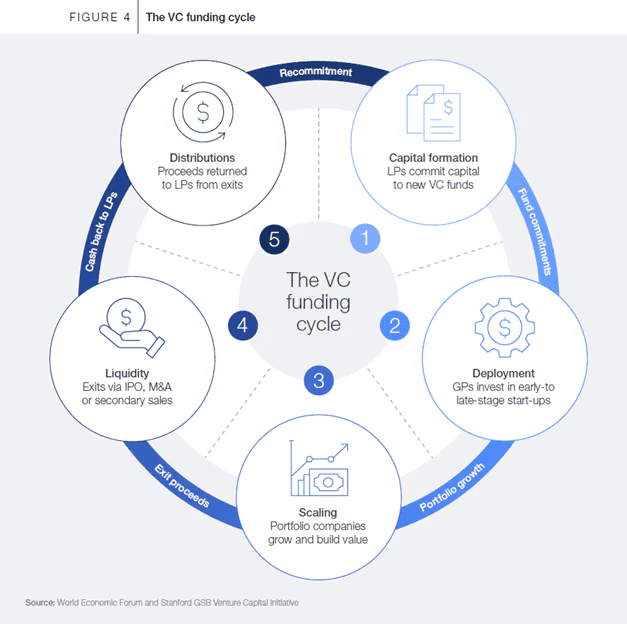
The WEF/Stanford report highlighted the throughput of capital flowing through the cycle: invest → grow → exit → distribute → recommit. Right now, the constraint is liquidity at exit; companies stay private, distributions to Limited Partners have fallen to historic lows, and trillions sit unrealized.
For climate, digital infrastructure and industrial venture capital the “missing middle” is a constraint; the scaling stage where technology, infrastructure and offtake risk converge and where coordinated patient capital is scarce. Identifying and solving this constraint when doing early-stage investment is a key competency for a climate, energy and industrial venture capital firm.
So yes, maybe the world of venture capital has become weirder, not because of the napping during a pitch, but because of the convergence of the physical and the digital worlds, the opportunity of physical science-based investments and the system level constraints creating opportunity. Weird that not more capital is flowing into these opportunities while digital infrastructure / AI companies can trade at 80 times annualized revenues, where defense companies trade at 1,5-2 times sales.