Blog
Industrial Transition Pathways
The possibility for resource intensive industries reducing their emissions is closer than most people think, but only if the right forces align at the same time.
Fred van Beuningen
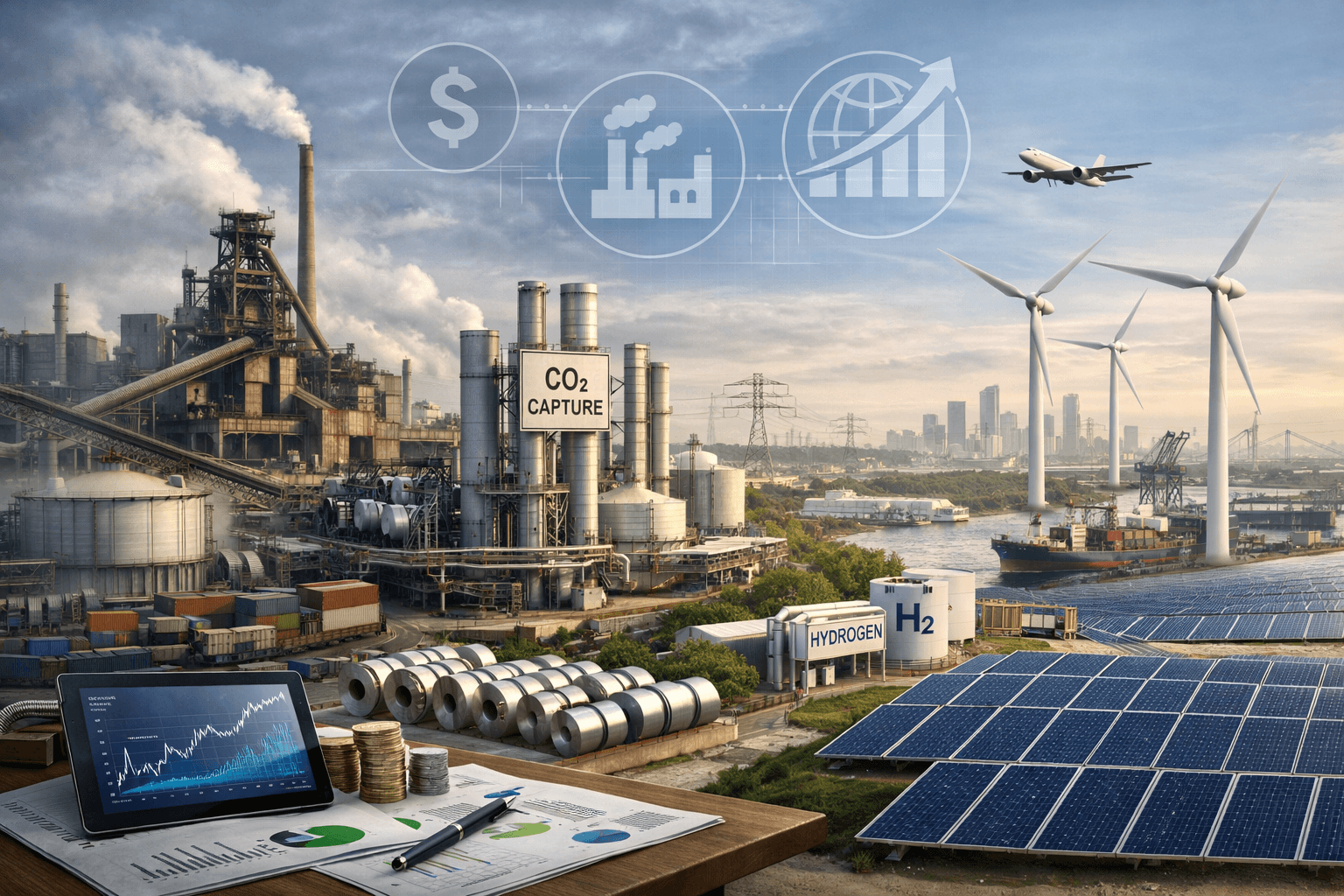
Industrial transition pathways are the main routes industries use to move from today’s carbon-, resource-, and cost-intensive models toward more competitive, low-emission, and resilient systems. These pathways have dependencies and add up to a system change.
Electrification and clean power are the backbone of defossilization.
Alternative fuels and carbon capture and utilization are needed for hard to abate sectors.
Renewable feedstocks and circularity promote long term, structural positive change.
Different views circulate on technology readiness and commercial viability of some of the technologies supporting industrial transition pathways. For example, plasma-based steelmaking, novel binders for cement, carbon utilization for chemicals, efuels, biochemicals, recyclable polymers, self healing materials, long duration energy storage, or electrification of high temperature processes, are mostly in lab and pilot stage and may have challenging fundamental economics, even when high efficiency is achieved through innovation as in the case of DAC.
The recently (December 2025) published World Economic Forum (Accenture) report: Scaling the Industrial Transition: Hard-to-Abate Sectors and Net-Zero Progress in 2025 declares that now is the decisive period for industrial transition. Technologies to cut emissions in hard-to-abate sectors are proven, with half of industrial emissions already abatable using mature solutions – the focus must now shift to scaling these solutions globally and profitably. The report evaluates eight sectors responsible for nearly 40% of global greenhouse gas emissions. While progress is evident, it remains uneven due to high costs, policy fragmentation, and infrastructure gaps. The report focusses on four key conditions:
Economic viability: Scaling depends on cost competitiveness, financing models, and risk sharing.
Integration: Coordinated investment in grids, hydrogen infrastructure, ports, and industrial clusters is critical. Current grid spending is insufficient to meet net-zero goals.
Accountability: Carbon intensity verification is becoming central to licensing, financing, and trade. Policies like the EU’s CBAM and ETS are expanding.
Innovation: The main barrier to progress is not technology but unclear policies and unreliable demand. Few hydrogen and CCUS projects have reached final investment decisions.
Challenges mentioned include: the transition faces regional divergence, strained infrastructure, and system interdependence. AI and digitalization are driving electricity demand, while supply chain concentration in critical minerals is a growing concern.
The report concludes: success in achieving net-zero industrial systems by 2050 will depend on collective action among markets, governments, and industries to align demand, policy, infrastructure, and capital for scalable, clean technologies.
About 63–65% of the world’s largest publicly traded companies (e.g., those in the Forbes Global 2000 or among the largest 2,000 by revenue) have some form of net-zero emissions target. These figures generally refer to commitments announced, not necessarily credible, comprehensive plans that fully align with the Paris Agreement (which would require covering all emission scopes and detailed implementation pathways).
A tipping point for the industrial transition to net-zero emissions happens when non-clean options stop being the default economic choice. Historically, industrial transitions accelerate when multiple forces reinforce each other at once rather than from a single breakthrough.
Cost parity or green premium
Learning curves (CAPEX falls 15–30% per doubling of capacity), scale manufacturing (electrolyzers, heat pumps, electric kilns), cheap clean power, carbon pricing and fuel volatility risk. Lower cost of ownership can accelerate technology adoption as well.
Infrastructure lock-In
Industry is conservative not because of ideology, but because of asset lifetimes. The tipping point occurs when new infrastructure (grids, hydrogen pipelines, CO₂ transport, biorefineries) becomes widely available, retrofit risk falls below greenfield risk, insurance and lenders treat fossil assets as stranded-risk liabilities. These conditions can remove the “first mover penalty.”
The cost of inaction
Regulation that is credible and irreversible. Examples are carbon border adjustment mechanisms (CBAMs), mandatory product carbon intensity disclosures, and public procurement standards for low-carbon steel, cement, and chemicals. The key is setting expectations: once companies believe rules will tighten, capital reallocates early.
Demand pull from buyers
Industry responds to anchor buyers. Tipping point can occur when OEMs (auto, construction, tech) sign long-term offtake contracts, low-carbon materials become specification requirements, and price premiums shrink due to scale and branding risk.
Capital markets repricing carbon risk
Transitions also accelerate when capital markets move faster than policymakers. This can be demonstrated by higher cost of capital for carbon-intensive projects, insurance withdrawal from high-emission facilities, and shareholder litigation risk around transition plans.
Technology stack maturity
No single technology causes the tipping point. It’s technologies converging. Examples are clean molecules (hydrogen, bio-based, e-fuels), electrification of heat, digital optimization (AI, energy management). A reliable “stack” leads to faster adoption of new technologies and enables conservative industries to move more quickly towards adoption.
Narrative
Every major industrial transition tipped when it became a productivity narrative, instead of a moral appeal or catastrophe story. When we start to hear “if we don’t transition, we will lose cost position, talent, capital, and market access,” it tips.
Tipping happens when new industrial CAPEX is low carbon by default, fossil projects require exceptional justification, transition timelines compress from decades to years, and late adopters face supply chain exclusion.
The industrial net-zero tipping point will be triggered when economics, infrastructure, regulation, and capital markets align simultaneously. Climate concern has started the conversation—but cost, risk, and competitiveness must accelerate it.
The system level analysis is part of the Chrysalix thesis building and early evaluation of technologies, as well as first scientific principles, cost to value, and convergence of drivers in place and time. Industrial transitions are fundamentally about sustainability, sustainable business models, license to operate, sustainable financing and efficient adoption of new technologies. Long term value is created by good strategy and execution and efficient conversion of inputs to outputs, with less energy, waste and other externalities. Good management is already working on it.