Blog
Digging Into the Critical Minerals Opportunity
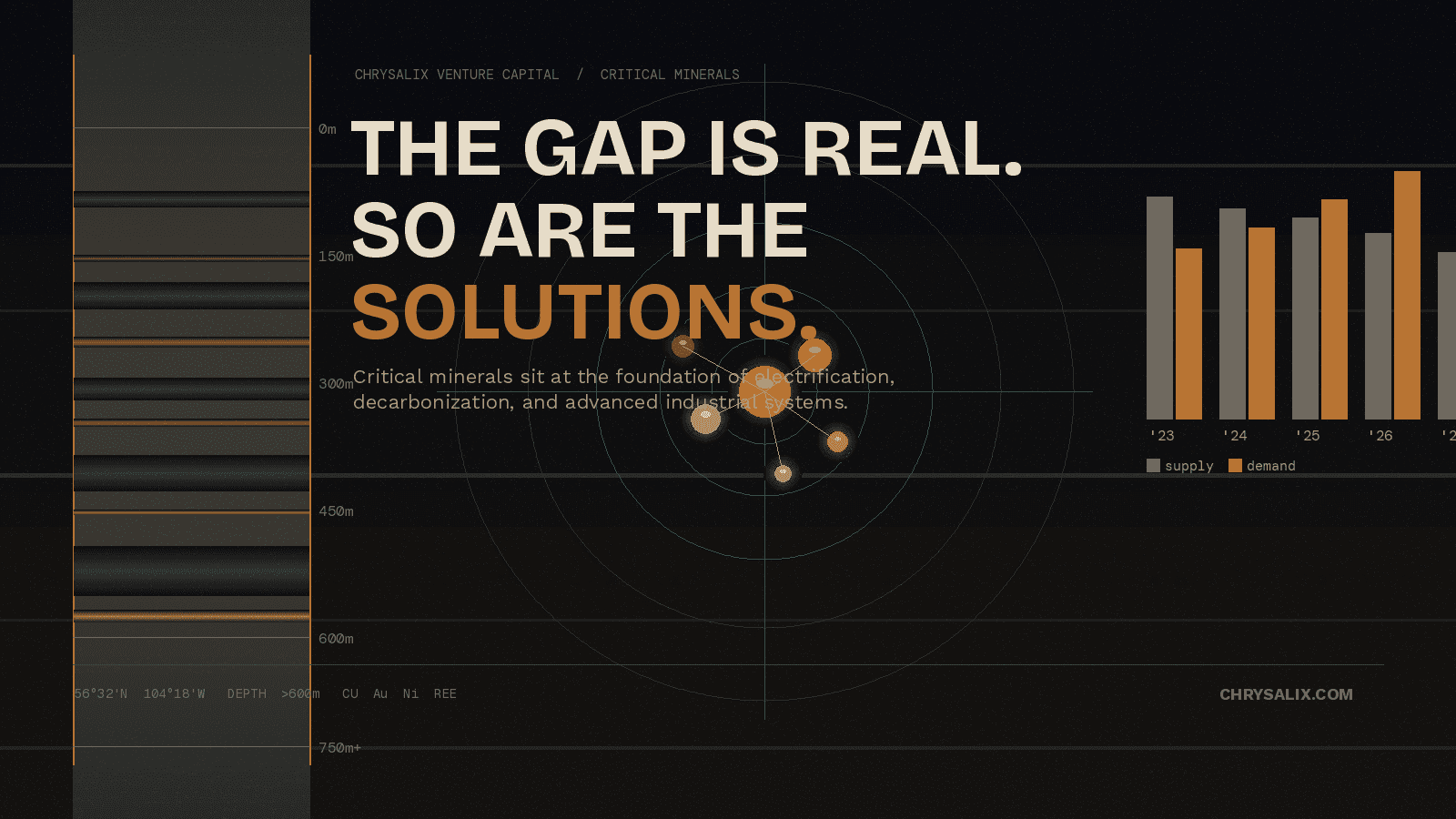
As the energy transition accelerates, the minerals that power it are becoming as strategically critical as the technologies themselves - and the gap between supply and demand is widening faster than the market can handle.
Nicholas Andruschak
Chrysalix Venture Capital has a long history of investing in mining and resource-intensive industries and scaling breakthrough technologies that improve efficiency, sustainability, and productivity. Through its LP base and broader industrial innovation strategy, Chrysalix leverages its deep network of industrial partners to identify “problems that matter” that, if solved, would unlock step-change economic, strategic and sustainable value for resource-intensive industries.
The Chrysalix approach is early-seed stage (often as the first institutional investor), problem-focused and thesis-driven investing. Since our investment into MineSense in 2013 from our third fund, we have seen the cyclicity of the mining sector and have built what we believe to be a robust thesis of what company profiles can deliver near-term step change value in a sector known for being CAPEX heavy with long adoption cycles.
This focus continued into our 4th Fund (RoboValley), in which over 60% of the portfolio is focused on critical minerals, and a significant percentage of our LP base is from across the mining value chain. Now in our 5th fund, these insights and core thesis development continue to drive our capital allocation.
Problem and opportunity summary
Critical minerals have become strategically urgent as they sit at the foundation of electrification, decarbonization, and advanced industrial systems. Copper, nickel, lithium, and other battery and energy-transition materials are no longer niche commodities, they are essential inputs. At the same time, supply chains are now increasingly exposed to concentration risk and geopolitical friction, elevating critical minerals from a market concern to a strategic priority for governments and industry leaders alike.
The current imbalance is structural and potentially accelerating. Demand is rising sharply due to the energy transition, AI, electrification of transport, grid expansion, and digital infrastructure, while supply growth remains slow and constrained.
Primary Feedstock Supply Side Opportunity and Challenges
The mining sector faces multiple compounding bottlenecks. Discovery rates for high-quality deposits continue to decline, permitting processes have grown longer and more uncertain, and capital intensity has increased significantly. Simultaneously, operators are under pressure to reduce environmental impact, waste, and water use while improving safety and community outcomes. These constraints make large, conventional greenfield projects increasingly difficult to execute within acceptable timeframes and risk profiles.
Declining ore grades: Average copper grades at producing mines have fallen steadily over decades, meaning significantly more material must be mined, moved, and processed to produce the same amount of metal. For example, in terms of copper This drives higher capital intensity, operating costs, energy use, water consumption, and emissions, while also increasing project timelines and execution risk.
rising mineralogical complexity. New copper resources are increasingly characterized by harder ores, finer grain sizes, more complex sulfide–oxide mixes, and higher levels of deleterious elements. These factors reduce metallurgical recoveries and require more sophisticated, site-specific processing flowsheets, often
Long lead times & permitting risk: Discovery-to-production can take well over a decade; permitting timelines, legal challenges, and community consent can materially delay (or stop) projects—making “pipeline” supply uncertain.
Capex intensity & cost inflation: New mines are larger, deeper, and more infrastructure-heavy, and costs (labor, equipment, power, reagents) have risen—so fewer projects clear investment hurdles.
Operational constraints: Water scarcity, power availability, and climate-driven disruptions (floods/droughts) increasingly hit output reliability.
Processing/refining bottlenecks & concentration: Even when mining expands, midstream capacity (and concentration in a few countries) can become the choke point, raising security-of-supply risk.
Resource nationalism & geopolitics: Export controls, local beneficiation requirements, and geopolitical tensions can constrain flows and increase project risk.
How this manifests is shown below for copper in which demand is expected to significantly outstrip possible supply, which supply gaps opening up as soon as 2027.
Fundamentally there are only a few levers to pull on the supply side, increase conventional capacity, increase productivity, unlock new resources (stranded) or increase secondary supply (increased recycling/circularity). However, the problem is even with aggressive recycling growth and incremental productivity gains, current project pipelines are insufficient to meet forecast demand without sustained high prices or breakthrough technologies.
Secondary Feedstock (Recycling) Opportunity & Challenges
Improving recycling is an often mentioned way to narrow this supply gap. However, there are several constraints that prevent scaling tonnages and limiting the potential of secondary feedstocks to compete on product output quality with primary feedstocks.
High variability of feedstock
Unlike mined ore, recycled metal feedstocks are extremely heterogeneous. Scrap streams vary widely by source (end-of-life products, manufacturing scrap, consumer waste), composition, contamination, and form factor. This variability makes consistent processing difficult, increases operational complexity, and requires sophisticated sorting, characterization, and blending to achieve predictable outputs.
Low and inconsistent metal concentrations
Many recycled streams, especially for critical and battery metals contain relatively low concentrations of the target material. Valuable metals are often dispersed across complex products (electronics, batteries, alloys) and mixed with plastics, ceramics, coatings, and other metals. This dilution drives up processing costs, energy use, and recovery losses, and can quickly erode margins if not managed carefully.
Complex separation and metallurgy
Modern products are not designed for recycling. Multi-material assemblies, advanced alloys, adhesives, and miniaturization make physical separation and metallurgical recovery challenging. Achieving high purity often requires multi-step processes (mechanical, thermal, hydrometallurgical), each adding cost, yield loss, and environmental burden.
Aggregation challenges, supply reliability and scale constraints
Recycling feedstock availability is constrained by product lifecycles and collection systems. Even with strong demand signals, supply cannot scale quickly and there is a lag between material use and end-of-life recovery. For rapidly growing markets like EVs, recycling alone cannot meet near-term demand, and inconsistent feedstock volumes make it hard to build large, capital-efficient facilities.
Economics tied to primary markets
Recycling economics are tightly coupled to primary metal prices. When commodity prices fall, recycled material can become uneconomic relative to virgin supply. At the same time, recyclers face many of the same cost pressures as miners: energy, reagents, labor, permitting without the benefit of long mine lives or guaranteed feedstock.
Regulatory and ESG tradeoffs
While recycling is often assumed to be “clean,” it still carries environmental and social challenges: hazardous waste handling, chemical use, emissions, and worker safety. Regulations vary widely by region, adding compliance complexity and limiting where facilities can be sited or scaled.
Solutions through innovation
When looking to identify solutions to “problems that matter”, important characteristics that Chrysalix looks for are ability to increase capacity rapidly (incl. improved throughput / yield), has top quartile cost advantage and can do it in an environmentally responsible way. Through iteration and experience we have found the following profiles to be potentially be successful across many traditional heavy industrial verticals by enabling more rapid adoption enabling near term value inflection. Which are not typically characteristics in these industries.
Name: | Waste – to – Value Profile | “Fracking” Profile | New Datasets / High Value Decisions |
Enabling Characteristic: | Ability to control ones own destiny through processing/upcycling waste feedstock and selling to multiple customers in a global market vs. having to seek first adopters who must install novel proprietary technology in which sales cycles are longer | Smaller, modular technologies that have enabling capability to unlock resources that would have otherwise been uneconomic (or stranded). Similar to how fracking unlocked new reserves in O&G. | New datasets that can drive new, high value, actionable decisions at points in which variability is introduced into an industrial process often can create substantial value for low cost. It is important that both the new decision and value are uniquely attributable to the new dataset by the customer to enable high value capture. |
Critical Minerals Portfolio Examples: |   |  |    |
Examples:
Waste – to – Value Profile: – Our Portfolio company Voro Metals is an example of this profile. Voro Metals has developed a solution to upcycle scrap steel (typically 0.2-0.5%wt Cu) by removing the contaminating tramp copper to <0.06%wt, the threshold necessary to enable upcycling into high grade products such as auto sheet. For a secondary (EAF) producer, this enables upcycling of outputs and a reduction in cost and addition of less dilutive iron units to achieve specification. This company was a company that arose from a Chrysalix incentive challenge with one of our LP’s, Mitsubishi Mining & Metals.
“Fracking” Profile: – Our portfolio company Novamera is an example of this profile and has the potential to unlock high-grade, but steeply dipping veins that would otherwise be uneconomic to extract. Novamera has developed a breakthrough precision extraction method known as surgical mining. The approach combines proprietary hardware and software with conventional drilling equipment to precisely map, navigate, and extract high-value minerals from narrow, steeply dipping or otherwise difficult-to-mine deposits that are uneconomic using traditional methods. This enables faster path-to-production, smaller footprints, and potential reductions in permitting timelines
New High Value Decision making – Our Portfolio company Geopyora. Geopyora is a mining technology start-up focused on transforming how resource variability and rock breakage characteristics are measured and understood to improve exploration, geometallurgy and processing outcomes. Its core technology enables rapidly testing large numbers of small rock samples, generating high-resolution data on comminution and extraction behavior that when connected to its artificial intelligence platform can drive improved throughput and yield at mines.
Conclusion
In conclusion, the critical minerals challenge is not a distant, theoretical problem, it is a near-term constraint on the energy transition, industrial competitiveness, and geopolitical resilience. While structural bottlenecks in discovery, permitting, capital intensity, and environmental impact are real, they are not insurmountable and is dependent on new enabling, breakthrough technologies. Progress will come from focusing on pragmatic, scalable solutions that unlock supply faster, cleaner, and more efficiently than traditional approaches. By pairing deep industry insight with technologies that deliver clear value, the mining ecosystem has a credible path to closing the supply–demand gap and building more resilient critical mineral supply chains for the decade ahead.