Blog
Sustainability revisited
Fred van Beuningen

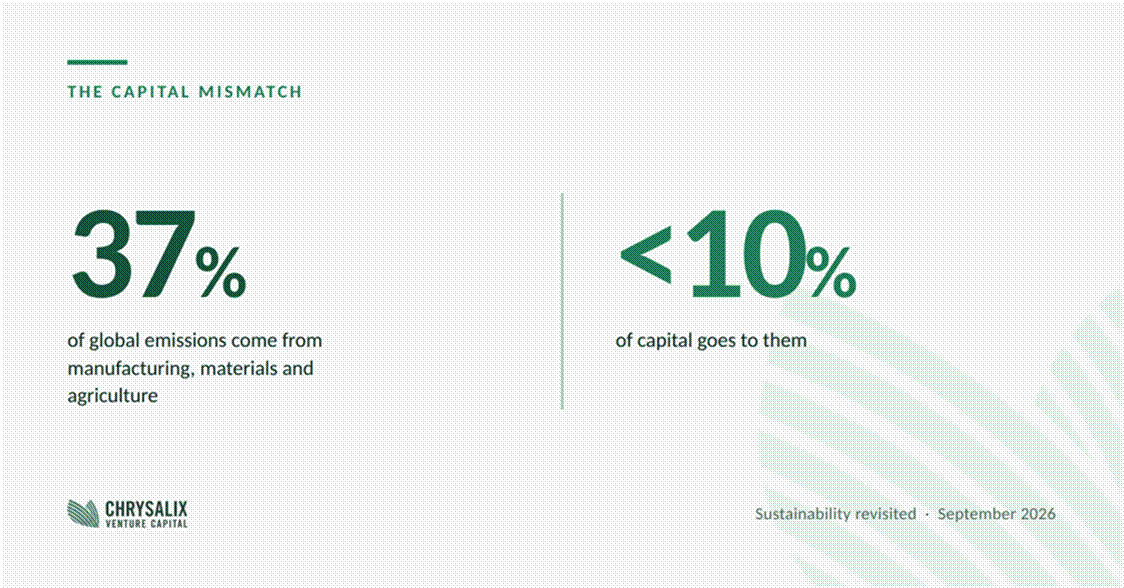
Bain & Company published the “Visionary CEO’s Guide to Sustainability, 2026”, stressing divergence across technologies and sectors. Solar and batteries strongly beat forecasts, but most other sectors fell short. Falling short can be explained by system dynamics: if one of the three “gates” — technology, policy and consumer behavior — remains shut, even a sound thesis stalls. Bain also explains capital divergence: while manufacturing, materials and agriculture represent 37% of emissions, they attract less than 10% of capital. The perception that the three “gates” must open simultaneously leads to capital concentration, leaving important technologies underfunded.
The lived experience of extreme weather and an increased emphasis on health and resilience drive consumer concern about sustainability. Willingness to pay more is put at 18% (24% if health benefits are added), implying that adding health and resilience benefits to sustainability wins both consumers and margin.
The report explains how the energy transition runs through Asia — China, India, Indonesia and South Korea, for example — driven by economic development, resource-driven strategies and energy security. The forecast for AI’s energy footprint is lower than that of industry executives; nevertheless, energy and asset efficiency remain an important lever (the IEA estimates 13+ exajoules could be saved by 2035). AI-enabled climate risk data reprices real assets and portfolios.
Bain’s working definition of sustainability seems tied to an energy transition towards a low-carbon, environmentally friendly system, measured in investment, emissions and physical risk. Chrysalix’s 5th Industrial Innovation Fund focuses on transitions in energy and materials. In industries like mining, chemicals, energy and cement, efficient use of resources, reduction of waste and substitution to more sustainable materials are important innovation themes. The energy transition and AI have a materials bill, imposing binding constraints on the speed and scale of the transition to renewable energy and the use of AI in industrial applications. Constraints create investment opportunity where technology is part of the solution: more efficient exploration and processing of materials, harvesting materials from waste, material substitution, circularity and alternative fuels, for example. Climate resilience and (AI-enabled) operational efficiency are long-term value creation principles, not nice-to-haves. Venture capital’s direct ownership and hands-on involvement are empirically linked to faster scale-up of new technologies.
In BCG’s report “Sustainability in Private Markets”, data support the conclusion that private companies make more progress on decarbonization strategies, with a bias towards Europe and larger companies. Logically, sectors under more commercial and policy pressure, like mining and power, show higher adoption of decarbonization strategies. More recently, BCG wrote about AI-enabled climate and sustainability solutions. The report explores how AI capabilities could create value in areas like industrial equipment, climate risk modeling, grid, storage and materials discovery. AI, however, is a double-edged sword: it is also an additional draw on the existing energy mix.
At its core, environmental sustainability is about resource efficiency: using less energy, fewer materials and generating less waste. Technology, rooted in physical science and optimized by software and AI, enables resource efficiency but scales more slowly than predicted. Technology, policy and value-chain orchestration all need to be in place. Investors with experience in industrial markets, science-based technology and scaling industrial projects direct capital to where it is needed most.
Resilience, rather than sustainability, is the term du jour. The new questions are about the insurability of critical assets; risk perception, which places climate risk in a similar category to cybersecurity — a must-have; and diversification of inputs and geographies.
We have made investments in alternative energy like fusion, but also in mining technology, advanced recycling and upcycling, and energy efficiency. Conviction-led, but with a clear eye on where the three “gates” — technology, policy and demand — open fastest and on similar timelines. Especially in resource-intensive industries, investments need to be holistically assessed through a venture-investing lens. Technology needs to work, with attractive unit economics, reasonable lifetime financing requirements and demonstrable functional benefits across the value chain. Our 25 years of experience and global network of industrial partners allow us to select, invest in and demonstrate industrial solutions for resource productivity and resilience.
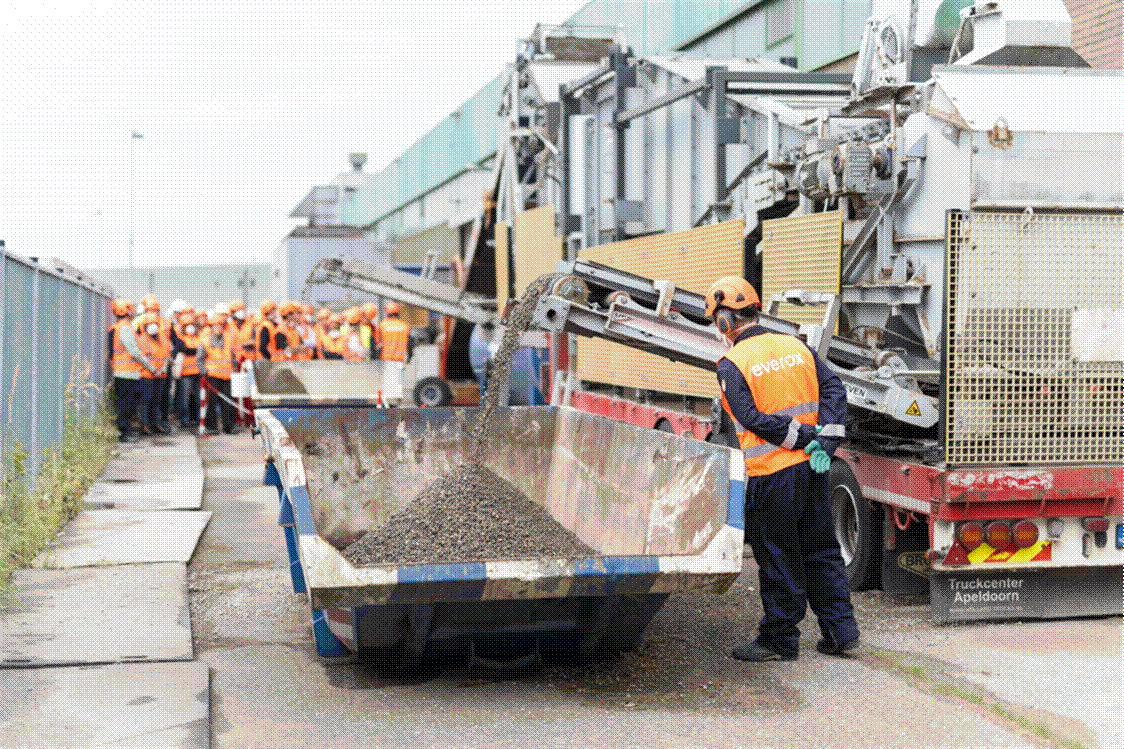
Everox, a Chrysalix portfolio company, demonstrating its mobile concrete recycling plant to industrial partners. Photo: Hannah Rosalie Photography.